Cross-Border Remote Work: Translation Tools for Families

When parents work for companies in different language zones, family logistics quietly fall apart.
Thirty-seven percent of EU jobs could technically be done from anywhere with a laptop and decent wifi. Estonia figured this out early, launching the world's first digital nomad visa in 2020. Since then, thousands of families have packed up and moved across European borders, chasing better weather, lower costs, or simply a change of scenery. What nobody warned them about: the daily chaos of managing school emails in Portuguese, pediatrician appointments in Greek, or utility bills in Polish.
For a simpler setup, Bridgecall offers browser-based video call translation with translated voice and live subtitles.
The invisible language crisis in cross-border family life
Consider a Dutch mother working remotely for a German company while living in Portugal. Her Spanish-speaking partner works for a French firm. Their children attend local Portuguese school. Every morning brings a cascade of languages: homework instructions in Portuguese, a Slack message in German, a school WhatsApp group mixing English and Portuguese, and a pediatrician appointment that requires explaining symptoms in a language nobody in the family speaks fluently.
This family isn't unusual. Research on the rise of remote work across borders shows that 37% of EU dependent employment could potentially be performed remotely, with information-processing tasks being most teleworkable. The result? Unprecedented family mobility. But also communication complexity that nobody prepared for.
Professional translation needs are well-documented. Companies budget for it. Contracts get checked. Legal documents go through proper channels. The daily family logistics across language zones, though, remain underexplored in research. Machine translation has been freely available since the mid-1990s and now includes speech recognition, text-to-speech synthesis, and optical character recognition. Yet we know surprisingly little about how families actually use these tools to survive multilingual daily life.
Here's what's becoming clear: translation tools aren't just work enablers. They're family-routine preservers. They determine whether these cross-border arrangements work long-term or collapse under the weight of small, daily miscommunications.
Grandparents, childcare, and the language gap across generations
The backup childcare plan looks simple on paper. Grandparents step in when work demands spike or school holidays stretch longer than annual leave. For cross-border families, though, this arrangement hits an immediate wall: language.
The childcare language gap often becomes the moment families realize translation is infrastructure, not a novelty. We explore that shift through multilingual grandparents.
A British father working for a Dutch company in Spain relies on his Polish mother for emergency childcare. His work calendar syncs to Dutch time zones with notifications in English. His mother speaks Polish and basic German. When a last-minute client call gets scheduled, coordinating coverage becomes a logistical nightmare. The shared family calendar means nothing if half the family can't read it.
Research on strategies adopted by families working remotely across borders highlights that cross-border workers need entrepreneurial characteristics, including the ability to organize time and arrange practical aspects of their work. This falls apart quickly when extended family members can't understand the constraints. A grandmother who doesn't grasp that "async standup" means her son absolutely cannot pick up the kids at 9 AM creates friction nobody anticipated.
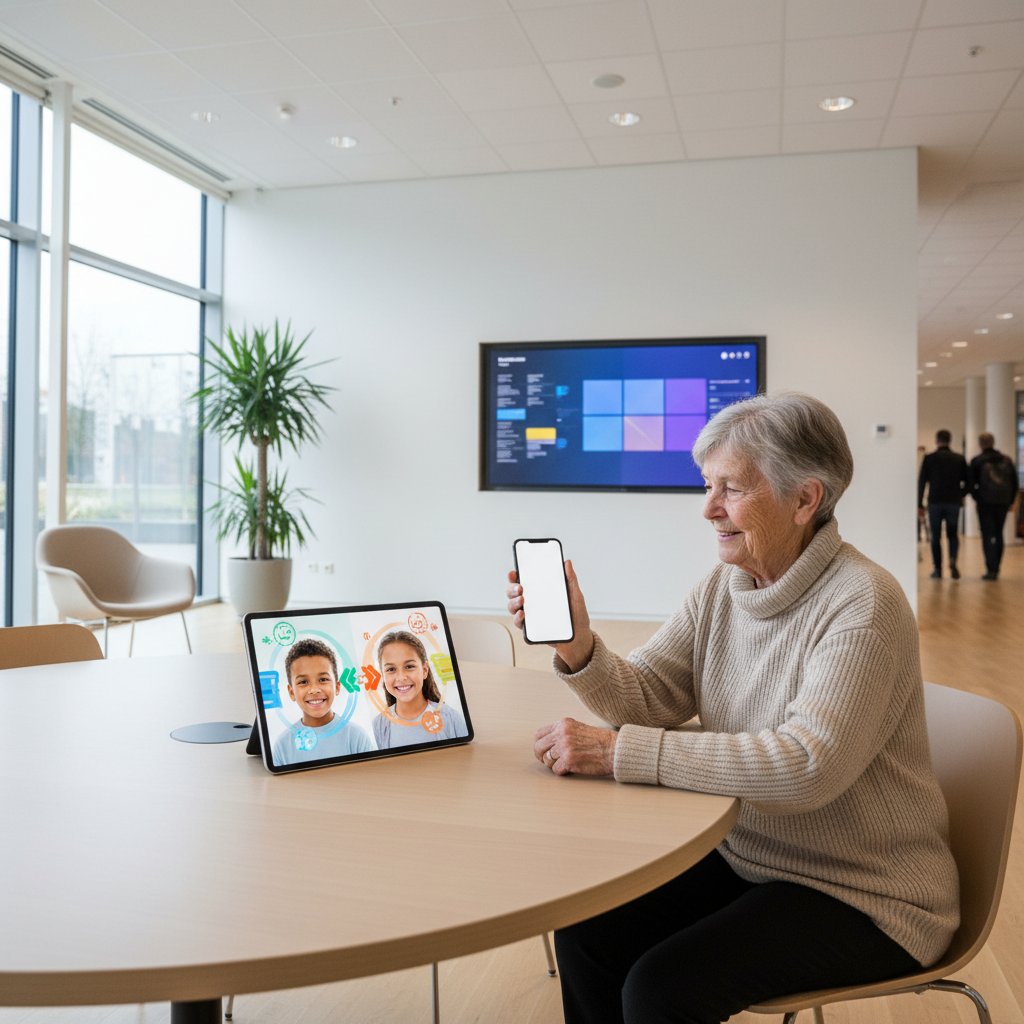
Text-based translation apps don't work well with elderly relatives who prefer voice communication. Many grandparents find typing on smartphones frustrating or simply refuse. A phone call translator bridges this gap in real time, allowing natural conversation without requiring anyone to learn new technology. The grandmother explains her schedule in Polish. The father responds in English. Both understand each other instantly.
School communications: Where free translation tools fail families
The daily paperwork pile tells the story. Permission slips for field trips. Lunch menu changes. Parent-teacher conference schedules. Emergency contact updates. All arriving in Portuguese, Greek, or Croatian, depending on where a family has landed.
Free translation tools handle the basics well enough. A simple "school closed Friday" comes through clearly. The problems start with specifics. Educational jargon varies wildly between countries. A Dutch term for a specific learning assessment doesn't translate neatly into English. Croatian administrative references to local bureaucratic processes leave parents guessing. And medication allergy forms, where precision matters most, become genuinely dangerous when "may contain traces of nuts" gets muddled.
Estonia, Croatia, and Greece have rolled out digital nomad visas specifically targeting remote working families. The research on machine translation usage shows these tools now include optical character recognition for scanning documents. Yet school systems in these countries weren't built for parents who need every single communication translated. Teachers send WhatsApp voice notes in the local language. Report cards use grading systems that don't match anything parents experienced growing up.
The cultural layer adds another challenge. A Portuguese school newsletter referencing "Santos Populares" activities assumes parents understand local traditions. Free MT translates the words. It doesn't explain that children need costumes by Thursday.
Families who make cross-border arrangements work long-term tend to build reliable translation routines early. Those who don't often find themselves blindsided by a missed permission slip or a misunderstood pickup authorization.
Household administration across borders: Medical forms, tradespeople, and banks
The paperwork mountain grows fast. Cross-border remote workers face five major problem areas according to EU guidelines: social security benefits, taxation, relations between countries with different tax rates, work vehicle use across borders, and lack of cooperation between participating countries. Every one of these requires communication in multiple languages, often with bureaucrats who speak only their native tongue.
Medical situations hit hardest. A child running a fever at 2 AM needs a parent who can explain symptoms clearly to an on-call doctor. Prescription instructions written in Greek mean nothing to an English-speaking parent measuring out antibiotics. Vaccination records from the Netherlands need translation for Portuguese school enrollment. The stakes are too high for guesswork.
Then there's the tradespeople problem. A leaking pipe demands a local plumber. Getting quotes when you don't speak the language creates real vulnerability. Families report being overcharged by 30 to 40 percent simply because contractors recognized they couldn't push back or compare prices effectively. Miscommunication about the scope of work leads to half-finished jobs or unwanted "extras" on the final bill.
Banking adds another layer. Cross-border workers already struggle to secure loans requiring proof of income from foreign employers. Language barriers in bank communications compound this. Mortgage applications, account alerts, fraud notifications. All arriving in the local language. All requiring immediate, accurate understanding.
When both parents have meetings: Real-time translation for family coordination
The calendar collision happens weekly. One parent has a 2 PM call with German colleagues. The other has a client presentation in French at the same time. The Portuguese-speaking babysitter arrives in fifteen minutes and needs instructions about the toddler's nap schedule, the school pickup time, and the fact that the older child has a playdate afterward. Three languages. Five minutes to coordinate. No room for misunderstanding.
Coordination calls also expose whether video translation can handle interruptions, tone, and mixed-language households. The practical comparison is in translation apps for family video calls.
Central and Eastern European countries are making this scenario more common, not less. Estonia, Czechia, Poland, and Romania are positioned to become global remote work hubs. Fast broadband, strong digital infrastructure, wide adoption of digital services in the private sector. The appeal is obvious. But families settling in these regions now span even more language zones than before. A Romanian nanny, Hungarian in-laws, Slovak pediatrician. The linguistic web grows with every practical arrangement.
Translation technology built for boardrooms is finding a second life in kitchen coordination calls. The same meeting translation services that handle formal business contexts work just as well for a three-minute childcare handoff. Quick logistics don't require less accuracy. They require more. A misheard pickup time creates real problems when both parents are locked in video calls.
The pattern is clear across cross-border families who make remote work sustainable. Professional-grade translation tools aren't reserved for client meetings anymore. They're running in the background during babysitter briefings, after-school activity changes, and last-minute schedule swaps.
Making cross-border family life sustainable: What actually works
Belgium offers a useful model for thinking about remote work support. The country provides vouchers called werkbaarheidscheques for companies seeking professional advice on organizing telework with attention to worker well-being. Career coaches assess both professional and psychological impact. Monthly surveys help target sector-specific support.
The missing piece in all of this? Family communication support. Governments and employers focus on the worker. Nobody addresses the household infrastructure that keeps the worker functional.
Step 1: Map which communications require real-time accuracy.
Medical appointments, emergency childcare coordination, school allergy forms, banking alerts. These need professional-grade translation. A misunderstanding costs time, money, or worse.
Step 2: Identify where free tools work well enough.
Restaurant menus, casual neighbor chats, basic shopping. Google Translate handles these fine. No need to overcomplicate low-stakes moments.
Step 3: Build translation into daily routines, not emergencies.
Families who treat real-time translation as infrastructure, not a last resort, report smoother operations. The grandmother calls get scheduled. The babysitter handoffs run cleanly.
The pattern across successful cross-border families is consistent. Professional-grade translation tools run alongside free ones. Each has its place. The mundane moments, the 2 PM schedule swap, the medication explanation to the pharmacist, determine whether these arrangements last.
Translation tools are infrastructure now. For families who've built lives across language zones, they're as essential as wifi.
Try Bridgecall free for your next family call across language barriers and see how real-time translation keeps your cross-border household running smoothly.
Related Bridgecall Guides
How to Translate a Phone Call Without an App
Use one browser link for a voice-only translated call with no guest installation.
Video Call Translation
Start browser-based translated video calls with voice and subtitles.
Phone Call Translator
Start voice-first multilingual conversations without app installation.
Google Translate Live Calls: The Hidden Cost for Families
Google's new live translation for calls promises to connect families across languages.
Translation Earbuds vs Phone Apps: The Dependency Issue
Translation earbuds promise seamless communication, but most require a connected phone to function.
Translation Latency in Family Calls: The 3 Second Problem
When your toddler says their first full sentence to grandma, a 3-second translation delay turns magic into awkwardness.
Ready to start multilingual calls?
Create a Bridgecall room in minutes and let everyone speak in their own language.
Get started