Live Call Translation in 2026: Impact on Families Abroad

In 2026, Google and Apple made live call translation mainstream.
A grandmother in Portugal can finally hear her grandson's voice in Lisbon and understand every word, even though he only speaks English. That's the reality of 2026. Google's Live Translate now works across 70+ languages on iPhones and iPads, preserving not just words but tone and emphasis. For the millions of families split by borders and languages, phone calls are becoming actual conversations again.
The calls families stopped making
There's a pattern that repeats in multilingual families across Europe. The weekly video calls become fortnightly. Then monthly. Then they quietly stop altogether, replaced by photos sent through WhatsApp and the occasional emoji reaction.
The exhaustion is real. Grandparents in Valencia who only see pictures of their grandchildren in Munich because the kids only speak German. Couples in long-distance relationships who default to texting because real-time conversation felt impossible when every sentence needed mental translation. The cognitive load of trying to communicate across a language barrier, especially for older relatives, turns a simple catch-up into work.
Families tried everything. A bilingual cousin translating in the background while the call grew awkward with pauses. Switching to text-only chat where Google Translate could help, losing all the warmth of hearing someone's voice. Or simply accepting that some relationships would stay on the surface, limited to birthday messages and holiday greetings.
None of these were technology preferences. Nobody chose photos over video calls because they liked it better. The language gap just made real conversation too hard, and over time, people stopped trying. Connection faded not because anyone wanted it to, but because talking was exhausting.
That slow drift apart, the relationships that never quite deepened, the grandparents who became strangers. That's what was really at stake.

What Google and Apple launched in 2026
March 2026 marked a turning point. Google rolled out Live Translate with headphone support for iPhone and iPad, covering more than 70 languages. The real breakthrough? The technology preserves tone, emphasis, and cadence. Voices sound like voices, not robots reading a script.
Apple took a different path. Live Translation now runs directly inside FaceTime and the Phone app, processing everything on the device itself. No data leaves the phone. The trade-off is a smaller language list: English, French, German, Italian, Portuguese, Spanish, Chinese, Japanese, and Korean. For families spread across Europe, that covers most situations.
Google's approach handles the connectivity problem that plagues international calls. The Gemini-powered conversation mode works offline thanks to on-device processing. A grandmother in rural Portugal with spotty internet can still have a real conversation with her grandson in Lisbon. The translation keeps running even when the signal drops.
What matters here is what disappeared. The awkward pauses while someone mentally translates. The bilingual cousin hovering in the background. The slow drift toward text-only communication because speaking felt too hard.
Translation now happens during the call itself. Not before, not after, not in a separate app. The technology sits invisibly between two people who simply want to talk. For multilingual families, that invisible layer changes everything.
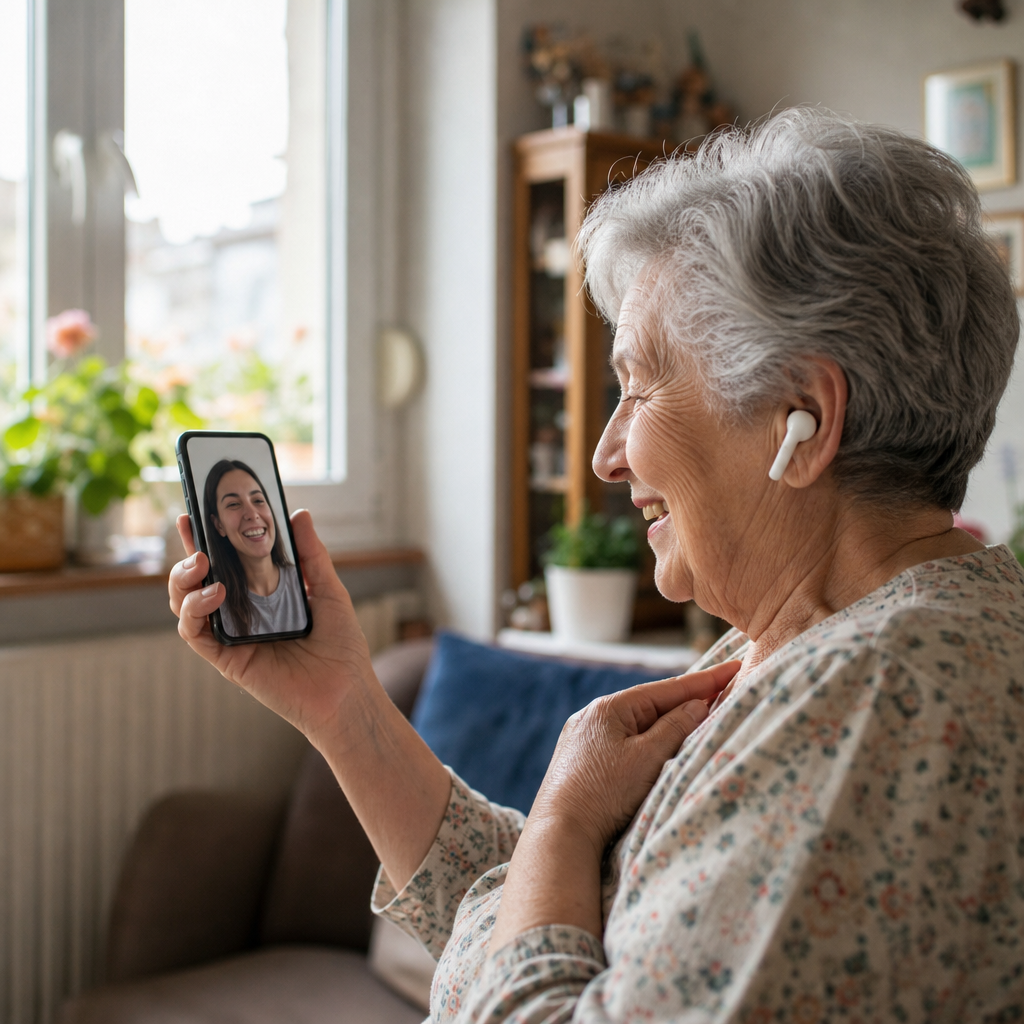
Scenario one: Grandparents hearing their child's real voice
Maria, 74, lives in Porto. Her daughter moved to Amsterdam fifteen years ago, married a Dutch man, and now speaks Dutch at home. For years, their calls felt distant. Not because of geography, but because Maria couldn't understand her daughter's daily life without someone translating in the background.
That changed when Maria put in her AirPods and called her daughter directly using a phone call translator.
- Her daughter's voice came through with its familiar warmth, the slight rise when she's excited, the softness when she's tired. Google's Live Translate preserves natural voice characteristics, so laughter sounds like laughter and concern sounds like concern. Not flat output from a machine.
- The old way meant Maria's bilingual grandson had to sit beside his mother, repeating everything in Portuguese. Private conversations became group exercises. Intimate moments felt staged.
- Now Maria handles the technology herself. No app switching, no waiting for her tech-savvy grandchildren to set things up. She puts in her earbuds and talks. That independence matters more than most people realise.
- The translation happens in real time during the call itself. When her daughter sighs about a hard day at work, Maria hears the sigh. When she laughs about something the kids did, the laugh comes through first, then the words.
For the first time in years, Maria knows what her daughter actually sounds like when she's happy.
Scenario two: Couples who stopped switching languages
Long-distance multilingual couples know a particular kind of exhaustion. Elena speaks Spanish, her partner Thomas speaks German. For three years, their evening video calls meant constant code-switching, mid-sentence pauses to find the right word, and a strange tiredness that had nothing to do with the time difference. They loved each other. They just dreaded calling.
- The mental load was invisible but constant. Every sentence required translation in one direction or the other. Whoever spoke their second language carried the heavier burden, and after an hour, both felt drained rather than connected.
- Now each speaks their native language. Elena talks in Spanish, hears Thomas in Spanish. Thomas talks in German, hears Elena in German. The cognitive weight that made long calls feel like work simply disappeared.
- The technical bar for this to actually work is high. Dedicated translation tools like DeepL Voice achieve 700 to 1100ms latency with accuracy 2 to 4 BLEU points above standard translation on European language pairs. That's the benchmark these platforms now aim for, and it shows in real conversations.
- What changed for Elena and Thomas: hour-long calls that feel like 20 minutes. Spontaneous calls on a Tuesday evening instead of carefully scheduled weekend slots. Inside jokes that land because timing finally works.
The language gap didn't disappear. The exhaustion did. And that distinction matters more than any feature list.
Scenario three: The child who stopped being the translator
Every multilingual family knows this child. The one who grew up switching between languages at the dinner table, who learned early that their role in family calls was to sit beside a grandparent and repeat everything the other person said. Eight years old and already carrying a weight that had nothing to do with childhood.
The pattern is exhausting in ways adults rarely acknowledge. A grandmother in Athens wants to tell her grandchild about the garden, but first the words go through the bilingual parent, then get repeated, then the response travels back the same way. Spontaneity dies. So does intimacy.
Google Meet's Adaptive Audio changes this dynamic entirely. The technology detects multiple speakers in a room and routes each to their own translation stream, handling over 100 languages. A family video call no longer needs a designated interpreter.
The shift looks small but feels enormous. An 8-year-old on a call with grandparents in Thessaloniki, showing off a drawing, laughing at a joke, asking about the neighbour's cat. Just being a grandchild. The adults talk to each other directly in the background, each hearing their own language, while the child plays.
What disappeared: the constant interruptions asking "what did they say?" The tired resignation on a child's face after an hour of translating adult problems. The relationships that stayed shallow because a kid stood in the middle.
Generations can finally speak to each other without a child carrying responsibility they never chose.
What becomes possible when translation is invisible
None of these stories are really about technology. They're about the phone calls that stopped happening, the relationships that stayed shallow, the grandparents who became strangers because talking was simply too hard. When translation disappears into the background, people start calling again.
The limitations remain real. Apple supports 10 languages, Google over 70. Most platforms bundle translation into paid plans or lock features to specific devices. A grandmother in rural Greece calling her grandson in Sweden might find her exact language pair isn't covered yet. Coverage is expanding, but it's not universal.
The direction is clear, though. Translation is moving from scheduled video meetings on laptops to spontaneous calls on mobile phones. From business platforms like Teams and Zoom to the everyday apps people already have installed. The gap between what's possible in a corporate meeting room and what's available during a Sunday call to family is closing.
For families who need a real-time voice translator now, across any device and calling app, dedicated solutions fill the gaps the big platforms haven't yet closed. The technology exists. The question is whether it reaches the people who need it most.
Want to call family abroad without language barriers today? Try Bridgecall free and speak naturally in your next call.
Related Bridgecall Guides
How to Translate a Phone Call Without an App
Use one browser link for a voice-only translated call with no guest installation.
Video Call Translation
Start browser-based translated video calls with voice and subtitles.
Phone Call Translator
Start voice-first multilingual conversations without app installation.
T-Mobile Live Translation vs. Apps: Which Will Mom Use?
The real question isn't which translation tool has better features.
Real-Time Translation App Problems That Hurt Family Calls
Translation apps promise seamless family conversations across languages.
Family vs Business Call Translation: Why Grandma Drops Off
The same translation technology that powers flawless business meetings often crashes during Sunday calls with grandma.
Ready to start multilingual calls?
Create a Bridgecall room in minutes and let everyone speak in their own language.
Get started