Lesser-Spoken European Languages: Why Dialects Break Calls

Your Portuguese grandmother's Alentejo accent or your partner's Sicilian-speaking nonna live just a few hundred kilometers from where translation apps
Google Translate covers more than 100 languages. DeepL outperforms it on quality but supports just 33. And yet, when your Basque grandmother tries to join a family video call, neither one can help her. The reality is stark: Europe has over 60 regional languages and dialects where voice translation ranges from "awkward at best" to completely unusable. We're talking about millions of people, often older relatives, left stranded on the other side of a language gap that technology still hasn't bridged.
The invisible language hierarchy inside Europe
The moment hits differently for every family. A Welsh grandfather opens the app, speaks clearly into his phone, and watches his words vanish into silence. A Frisian aunt in the Netherlands tries three different translation tools before giving up. A Sorbian great-uncle in eastern Germany sees his language listed, presses record, and gets back something garbled beyond recognition. The technology simply doesn't see them.
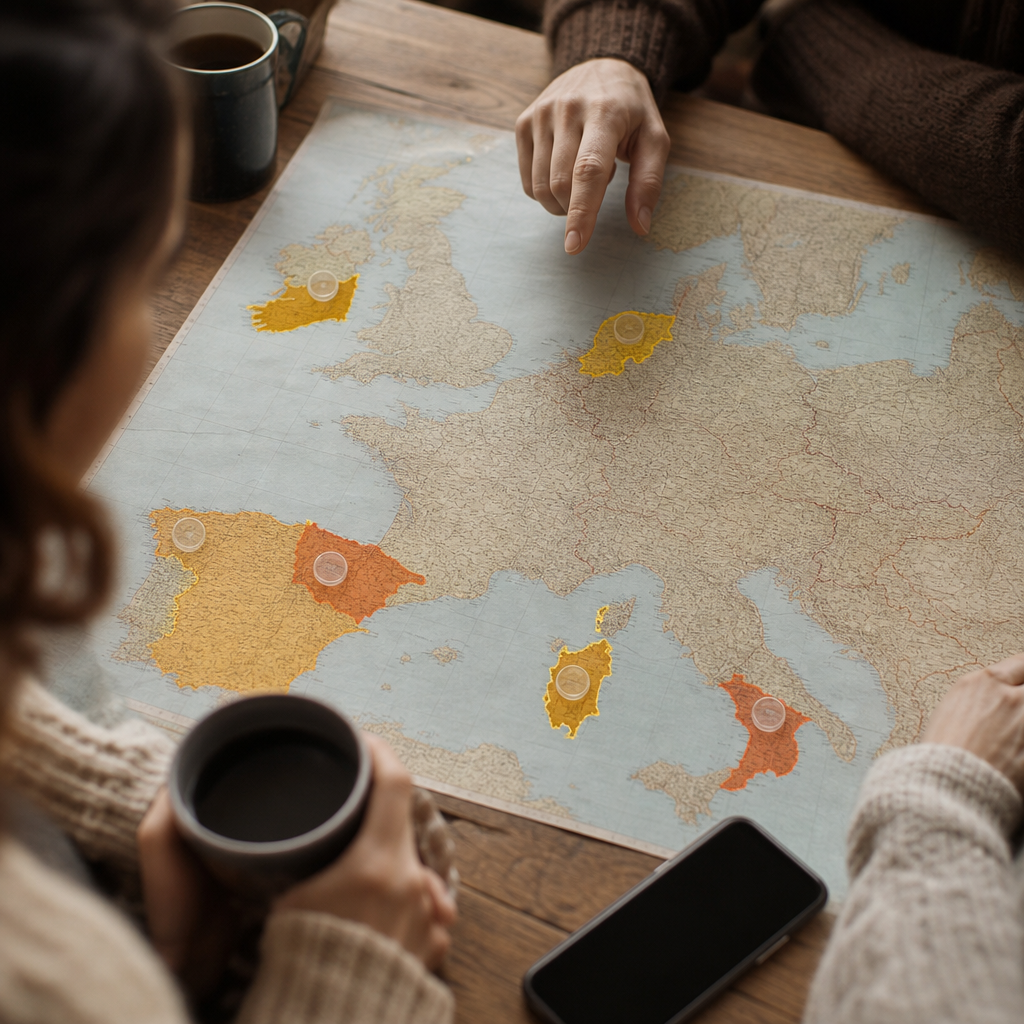
The data confirms what these families already know. Language coverage follows a dramatic hierarchy. The top 20 European languages get "very good" voice translation quality, enough for natural conversation. The next 30 sit in "usable" territory, with frequent errors and awkward phrasing that makes family banter feel robotic. Then there's everyone else. Regional languages like Galician, Catalan variants, Sicilian, Sardinian, and dozens of local dialects fall into "poor to unusable" for real family conversations.
The geography of this gap is striking. We're not talking about remote corners of the world. These are villages a few hours' drive from Paris, London, Berlin, and Madrid. A grandmother in rural Wales lives closer to major tech hubs than most American suburbs. Yet her language sits in a coverage gap that makes video calls with grandchildren abroad functionally impossible. The result is a patchwork continent where algorithmic inclusion follows economic value rather than human connection.
Why more languages does not mean better coverage
The marketing numbers tell a misleading story. Google Translate proudly lists 100+ languages. DeepL offers just 33. Yet in head-to-head quality tests, DeepL consistently outperforms competitors by 2-4 BLEU points on European language pairs. The smaller catalogue delivers better results.
This gap matters enormously for families. A language being "supported" can mean wildly different things. For Spanish or French, support means fluid, natural conversation where jokes land and warmth comes through. For Catalan or Welsh, support often means a checkbox on a marketing page. The app technically recognizes the language. It might even produce output. But the quality sits so far below usable that it creates more confusion than connection.
And here's where the real damage happens: false hope. Your grandmother sees Welsh in the dropdown menu. She downloads the app, sets up her phone, and waits for the family call. Then she speaks, and the translation mangles her words beyond recognition. Her specific regional accent, the one shaped by decades in her village, doesn't match the limited training data. The app heard her. It just didn't understand her.
The next time the family suggests a video call, she declines. Too much trouble. Too frustrating. The technology promised inclusion but delivered a reminder of the gap instead. Raw language counts are marketing metrics, not quality guarantees. And families pay the price for that difference.
When grandma stops sounding like grandma
Voice preservation is a critical but overlooked metric in translation technology. Technical comparisons focus on accuracy scores and latency benchmarks. Families measure something different: whether grandma still sounds like grandma.
Step 1: The warmth disappears first. Most translation tools flatten regional voices into standardized synthetic output. Your Sicilian grandmother's storytelling cadence, shaped by decades of village life, gets processed into generic Italian. The specific rhythm that made her stories captivating? Gone. The particular warmth of an Alentejo greeting? Replaced by clinical Portuguese.
Step 2: Humor stops working. Regional expressions carry cultural weight that standard language versions simply can't replicate. The joke that made everyone laugh at Sunday dinners lands flat when processed through a real-time voice translator trained on broadcast Spanish rather than Galician village banter. The endearment that always made you feel loved sounds robotic and distant.
Step 3: The lullaby loses its melody. This one hits hardest. Your grandmother sang you to sleep in her dialect. Now, when she tries to sing the same song to your children over video, the translation strips away everything that made it hers. The melody survives. The meaning survives. But the voice, her voice, does not.
The emotional dimension matters. Families don't need perfect transcription. They need connection that feels real.
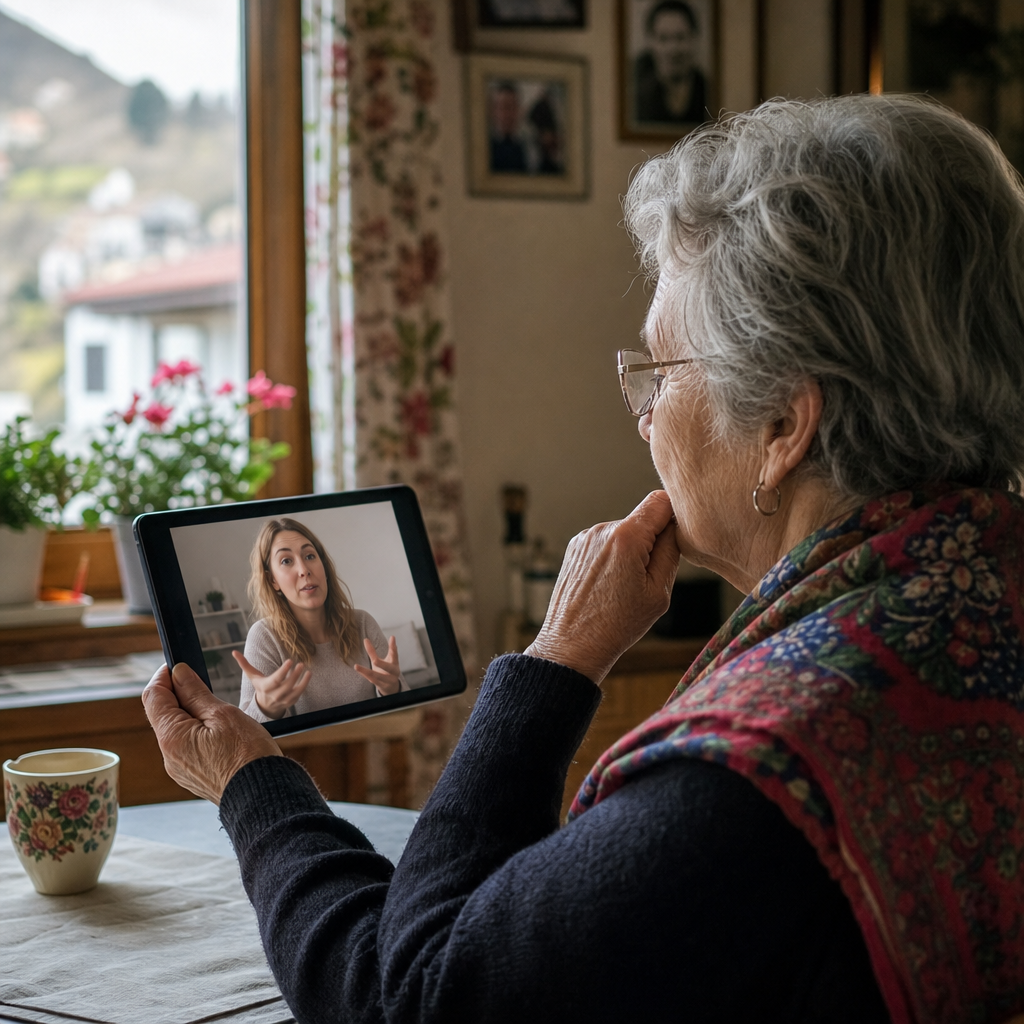
"She's still talking, but it doesn't sound like her anymore."
The silent dropout: When older relatives just stop trying
The family doesn't notice at first. The weekly video calls continue. But somewhere along the way, abuela stopped joining. She's "busy" or "tired" or "watching her show." The real reason sits unspoken: she couldn't figure out which button to press, and she's too proud to ask again.
This is the silent dropout. Non-technical older relatives don't complain about confusing interfaces. They don't send feedback to app developers. They smile politely and stop trying. The family assumes she's not interested. She assumes the technology wasn't made for people like her.
The button-press problem makes this worse. Real family conversations are messy. Children interrupt mid-sentence. Someone laughs before finishing their thought. A dog barks. Uncle Miguel comments from across the room. Most translation apps require manual queue management to handle this chaos. Press to speak, release to translate, wait for silence, try again. For a 78-year-old who grew up without smartphones, this workflow breaks the natural rhythm of conversation entirely.
Now add the dialect problem. Your Galician aunt already struggles with the app interface. Then she discovers her specific village accent doesn't register properly anyway. Two barriers instead of one. The math is simple: she stops appearing on calls.
The tragedy is invisible. Families assume distance is the problem. Geography gets blamed. But the real culprit is technology that demands too much from the people who need it most.
Travel tools versus family calls: Different problems entirely
The app that saved your vacation won't save Sunday dinner. The gap between transactional and relational communication is enormous, and most families discover it the hard way.
-
Context rescues transactions, but not intimacy. Google Translate in a crowded Osaka fish market produces roughly 1-in-5 word errors on regional Kansai dialect. Yet tourists still get their tuna. They point, gesture, hold up fingers for quantity. The vendor fills in the gaps. Try pointing at "I miss you" or "tell me about your week." You can't. Family conversations have no physical fallback.
-
Error tolerance drops to zero with emotion. Ordering the wrong fish is a funny story. Mangling your grandmother's health update is a missed connection you can't recover. Transactional mistakes get laughed off. Relational mistakes create distance.
-
Latency kills feeling before it kills meaning. Benchmarks range from 0.7 seconds to 2 seconds across different tools. Families don't measure milliseconds. They measure whether the joke lands. Whether she knows you understood. A phone call translator that adds even a beat too long turns natural conversation into awkward radio exchanges.
-
Vacation calls are short, family calls are long. Thirty seconds with a taxi driver is forgiving. An hour with your mother is not. Small errors compound. Fatigue sets in. The emotional thread frays.
The tools that worked brilliantly on holiday weren't built for the calls that matter most.
What families with lesser-spoken languages can do now
The honest truth: perfect translation for Galician village dialect or Frisian coastal accent doesn't exist in 2025. Pretending otherwise wastes time and, worse, sets up grandma for another frustrating call that ends in silence.
Families finding success right now tend to share a few things. They identify which relative speaks both languages well enough to bridge gaps when technology fails. They figure out which specific words or phrases break the translation most often, then teach relatives simple workarounds. "Say 'I feel good' instead of that regional expression" goes further than hoping the app catches up.
Setting expectations matters enormously. A quick conversation before the call, explaining that the technology helps but isn't perfect, removes the pressure. Grandma stops blaming herself when words come out garbled. The family stops assuming she's given up.
Patience becomes part of the process. Travelers discussing translator technology in Europe often mention combining apps with gestures, context, and repetition. Family calls work the same way. Slower speech, shorter sentences, and laughter when things go wrong keep everyone connected.
The deeper point is simple. Technology should make connection easier. It shouldn't create new hierarchies that tell your grandmother her language doesn't count. Until coverage improves, families bridge the gap themselves, imperfectly but together.
Wondering if Bridgecall works for your family's language? Tell us which languages you need, and we'll be honest about what's possible today.
Related Bridgecall Guides
How to Translate a Phone Call Without an App
Use one browser link for a voice-only translated call with no guest installation.
Video Call Translation
Start browser-based translated video calls with voice and subtitles.
Phone Call Translator
Start voice-first multilingual conversations without app installation.
Translate Phone Calls From Spanish to English: 4 Methods
Pick your Spanish to English translation method based on failure consequences, not features. Four approaches ranked by stakes and recovery options.
How to Translate a Phone Call Without Installing an App
Translate a voice call through one browser link. Learn what your guest needs, how to set it up, and when regular phone number translation is different.
Telehealth Call Translation: When to Use an Interpreter
Not every telehealth call needs a certified interpreter. Learn which health conversations require professional interpretation and when translation apps
Ready to start multilingual calls?
Create a Bridgecall room in minutes and let everyone speak in their own language.
Get started