Phone Call Translator Apps for Europe Travel 2026

Planning Europe travel in 2026? Learn which phone call translator options actually work across carriers, roaming scenarios, and low-connectivity
Phone call translation has quietly become a native feature on flagship devices. iOS 26, Samsung Galaxy phones, and T-Mobile's shortcode system now handle live voice translation without a separate app. For travelers heading to Europe in 2026, that changes the math on everything from asking directions in rural Portugal to sorting out a pharmacy visit in Prague. The question is no longer whether real-time translation works. It's which option actually holds up when you're roaming, crossing borders, or standing in a village with one bar of signal.
The Europe connectivity problem most travelers ignore
You're on a German ICE train rolling toward the French border. Your Airbnb host in Lyon needs to confirm your late arrival, but your UK roaming plan keeps dropping to "No Service" as the train crosses into Alsace. By the time you get signal back, you've missed the check-in window.
Europe travel stacks connectivity challenges in ways most people don't anticipate. Multiple carriers handle different regions. Roaming agreements vary wildly between providers. Rural stretches through the Alps or coastal Portugal can mean kilometers of dead zones. Border crossings trigger network handoffs that sometimes take minutes to complete, assuming they complete at all.
Then there's the translation layer. Most apps like Google Translate's conversation mode assume both speakers are in the same room, sharing one device. That works fine for asking directions. It falls apart completely when you need to call a pharmacy in Prague, reach a hotel reception in Barcelona, or sort out a rental car issue with someone who only speaks Italian. The other person doesn't have your app. They're not going to download one mid-call.
We're comparing what actually works for real phone calls to strangers, across European infrastructure, with spotty roaming and no app on the other end.

"The other person doesn't have your app, and they're not going to download one."
Native phone translation in 2026: iOS 26 vs Samsung vs carrier limits
The native translation features shipping with 2026 devices look impressive on paper. The reality for European travelers is more limited than the marketing suggests.
-
iOS 26 call translation requires a supported iPhone paired with AirPods, EarPods, or speaker mode. European carrier support remains patchy, with full functionality confirmed on major networks in the UK, Germany, and France, while smaller regional carriers often lack the necessary integration.
-
Samsung Galaxy devices handle translation through on-device processing, which helps with privacy. Availability across European markets varies by model and firmware version. Older flagship devices may not receive the feature at all.
-
T-Mobile's '87' shortcode offers a different approach, routing calls through their translation service. The catch: it only works on the US network. American travelers roaming in Europe lose access entirely, leaving them without their familiar carrier-based option.
-
Every native feature shares one weakness: stable data dependency. Train tunnels through the Alps, rural stretches of coastal Croatia, roaming throttling after you hit your data cap. Any of these breaks the connection mid-sentence.
For travelers who need reliable translation across multiple countries and network conditions, a dedicated phone call translator built for variable connectivity often outperforms native features that assume perfect signal. The gap between demo conditions and real European infrastructure remains significant.
App-based translation: What works when you call a French pharmacy
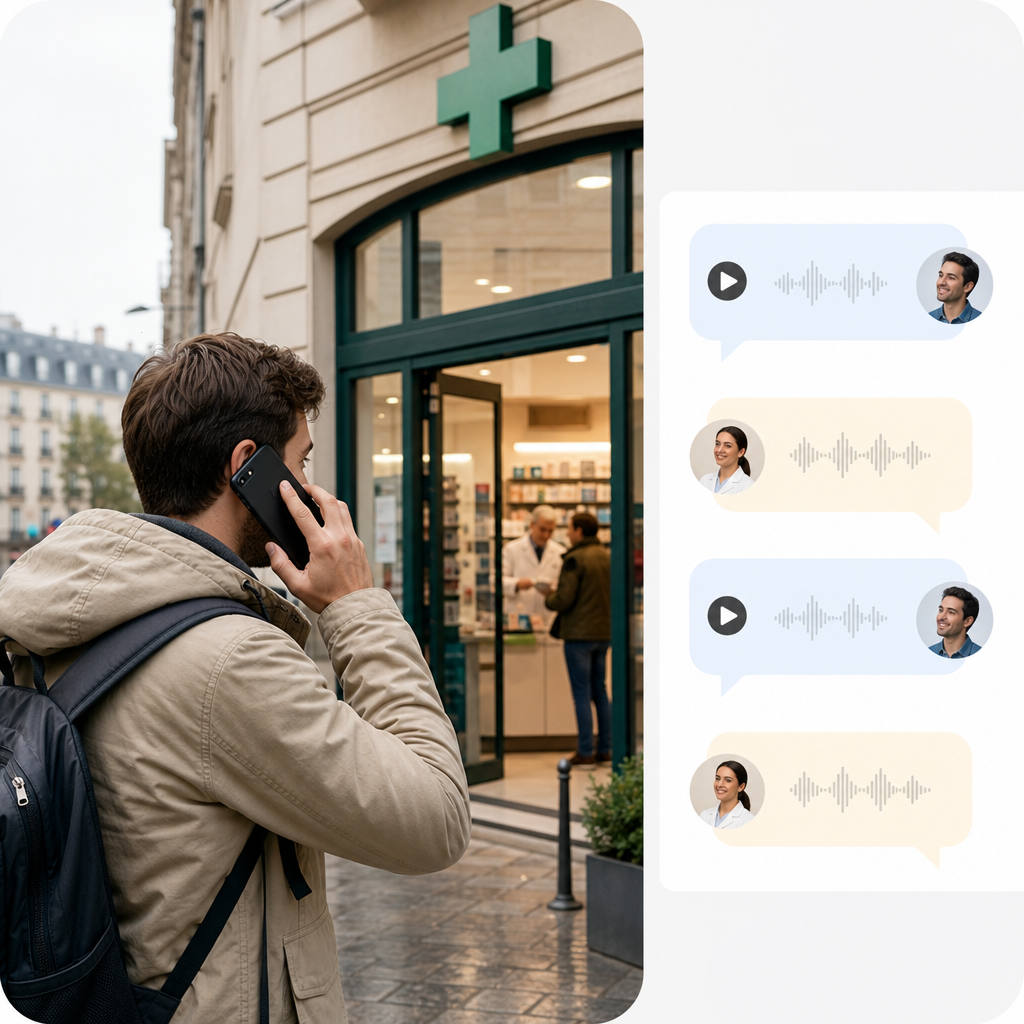
The pharmacy scenario reveals exactly where translation tools split into two categories. Most apps assume you're standing next to someone, passing a phone back and forth. Dedicated phone call translators take a different approach. They work with any regular phone number, no app required on the other end.
That distinction matters when you're calling ahead to a restaurant in Lyon, reaching a local pharmacy for medication advice, or confirming a booking with a rural guesthouse in the Dolomites. The person answering has a landline or a basic mobile. They're not downloading anything.
Latency separates the usable from the frustrating. Simultaneous voice translation apps deliver under 1 to 2 second latency. Turn-based tools like iTranslate, SayHi, and Apple Translate run 3 to 8 seconds per turn. That gap kills natural conversation. A pharmacist explaining dosage instructions won't wait eight seconds between sentences. Neither will a guesthouse owner trying to give you directions before their next guest arrives.
Pricing models have stabilized around pay-as-you-go rates of roughly $0.20 per minute from services like Lingvanex and Telelingo. Some apps offer free tiers with 3 minutes daily before paid plans apply. Recent analysis of the best translator apps for traveling abroad confirms that latency and phone number compatibility remain the two factors that separate practical tools from demo-ready ones.
One warning worth noting: EzDubs was acquired by Cisco and shut down in December 2025. Consolidation happens fast in this space. Choosing a stable provider matters more than chasing the newest feature.
Cost comparison: Apps vs human interpreters vs pay per minute
The pricing gap between human interpreters and app-based translation has become almost absurd. On-demand phone interpreters charge $3.95 to $4.95 per minute. A ten-minute call to sort out a hotel booking runs $40 to $50. Conference interpreters cost $150 to $400 per hour, and most require booking weeks in advance. That's fine for business delegations. It's overkill for asking a guesthouse owner about parking.
App economics work differently. Monthly subscriptions run $19.99 to $29.99, covering unlimited or high-volume use. Pay-as-you-go services from providers like Lingvanex and Telelingo charge around $0.20 per minute. Some apps offer free tiers worth testing. AI Call and LiveLingo both provide 3 minutes daily before paid plans apply.
The math for a typical Europe trip tells the story. Two weeks, ten short calls to pharmacies, restaurants, and local services. Maybe 30 minutes total. A human interpreter service bills $120 to $150. A pay-per-minute app costs $6. A monthly subscription covers the entire trip for a flat rate.
For travelers wondering how to translate a phone call without spending hundreds, the answer has shifted decisively toward app-based options. Human interpreters still make sense for legal matters or medical emergencies where precision carries real consequences. For everything else, the subscription model wins on both cost and convenience.
Language coverage for European destinations
Translation apps supporting 80 to 150 languages have become standard. The real differentiator is accent and dialect recognition. iFLYTEK's AI Translator 4.0, now available in Australia, covers 140 plus languages and 170 regional accents. That granularity matters more than raw language count for European travel.
Portuguese in Lisbon sounds different from Portuguese in the Azores. Bavarian German trips up systems trained on Hochdeutsch. Rural Provençal French carries vocabulary that Parisian training data never encountered. A real-time voice translator that handles these variations performs noticeably better than one that technically supports the language but stumbles on regional speech patterns.
Then there are the languages tourists encounter without expecting them. Catalan dominates Barcelona and the Balearics. Basque appears throughout the Basque Country on both sides of the Franco-Spanish border. Welsh signage covers much of Wales. Regional Italian dialects in Sicily or Sardinia diverge enough from standard Italian to cause confusion. Most apps now include these, but coverage depth varies significantly.
Offline mode separates practical tools from demo-ready ones. Alpine train tunnels cut data for minutes at a time. Ferry crossings between Greek islands mean extended periods without signal. Mountain regions across the Pyrenees, Dolomites, and Scottish Highlands create consistent dead zones. Apps that download language packs for offline use handle these situations. Those requiring constant data simply stop working when travelers need them most.
Practical setup before your Europe trip
Testing translation tools before departure separates smooth trips from frustrating ones. The gap between text translation and actual phone calls catches many travelers off guard. Text works fine. Voice over a real phone connection with background noise, accents, and spotty signal reveals whether an app holds up under pressure.
Travelers who test their chosen app on actual calls before leaving report far fewer surprises abroad. A quick call to a local restaurant or business in your destination language exposes latency issues that text demos hide. One honest review of the best travel translation apps found that real-world call quality varied dramatically between services that looked identical on paper.
Offline language packs deserve attention before boarding. Alpine tunnels and Greek island ferries don't wait for downloads. Roaming data allowances also trip up travelers who assume unlimited means unlimited. Many plans throttle speeds after 10 or 15 GB, dropping translation quality precisely when conversations matter most.
A quick pre-trip checklist worth running through:
- Confirm the app connects to regular phone numbers without requiring anything on the other end
- Test voice latency on an actual call, not just the demo mode
- Verify language pairs cover your entire route, including regional dialects
- Download offline packs for each country
- Check your roaming plan's throttling threshold
Try Bridgecall free before your next Europe trip and test real phone calls in your destination languages.
Related Bridgecall Guides
How to Translate a Phone Call Without an App
Use one browser link for a voice-only translated call with no guest installation.
Video Call Translation
Start browser-based translated video calls with voice and subtitles.
Phone Call Translator
Start voice-first multilingual conversations without app installation.
Translate phone calls from Spanish to English: app workflow
Phone calls are harder to translate than in-person chats. This workflow shows how to set up Spanish-English call translation and keep conversations
Telehealth Call Translation: When to Use an Interpreter
Not every telehealth call needs a certified interpreter. Learn which health conversations require professional interpretation and when translation apps
Translate Phone Calls From Spanish to English: 4 Methods
Pick your Spanish to English translation method based on failure consequences, not features. Four approaches ranked by stakes and recovery options.
Ready to start multilingual calls?
Create a Bridgecall room in minutes and let everyone speak in their own language.
Get started